In Conversation: Will Hackett-Jones
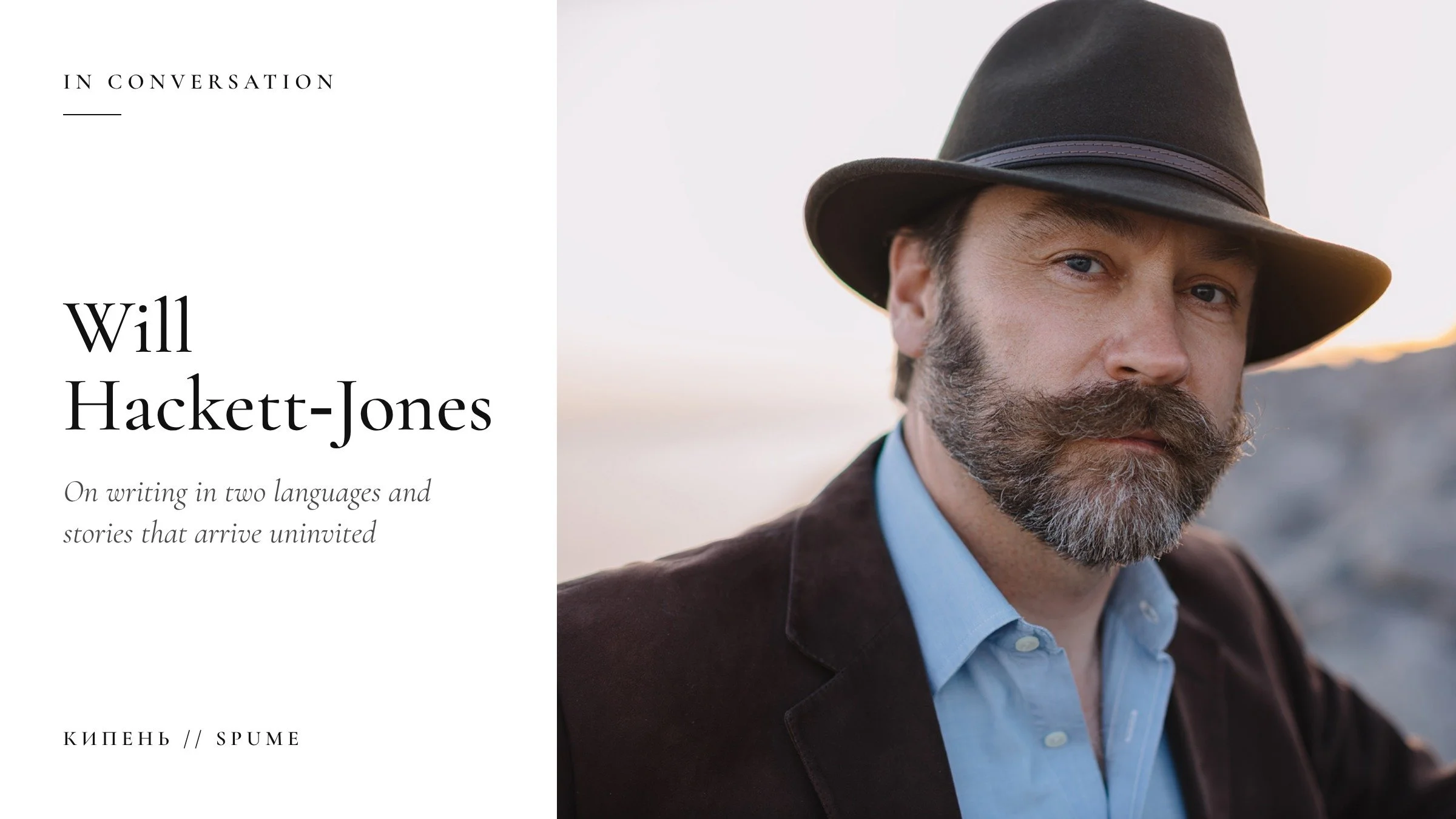
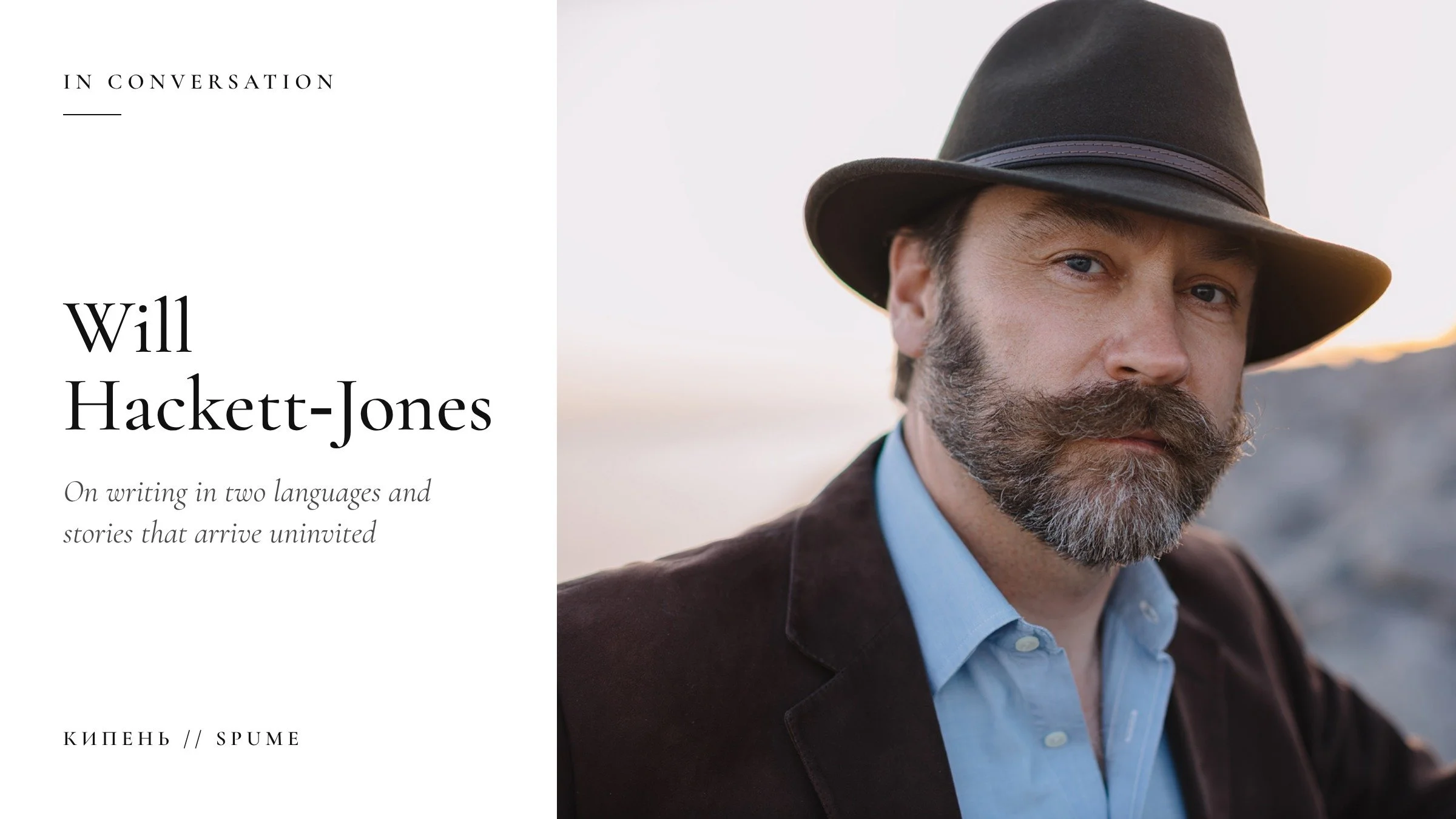
Will Hackett-Jones is a writer and translator who also runs the YouTube channel Шекспир плачет, where he interviews English-speaking expats living in Russia, in Russian. This time, we turn the tables and interview him, in English.
Will’s story, “His own set of car keys” (which is actually the first chapter of his upcoming novel Igor’s String Theory), appeared in the second issue of КИПЕНЬ // SPUME. We asked him about how he began writing, what working between Russian and English does to his prose, and the novels he is now writing in both English and Russian.
When did you begin writing, and what led you to it? Were there particular books, people, or experiences that set you on this path?
I began making stories up at primary school. My mother was so amused by some of them that she recorded them onto a cassette — now long lost. There was also a famous story about how I chucked a teacher I didn't like out of the window into the rose bushes. That was at about six. After that there were the usual school writing assignments which I enjoyed and my teachers seemed, on the whole, to find me adequate at.
But the moment I knew I wanted to write I remember to this day. Second year of high school, 14 years old. A friend's mother had obtained a second-hand computer for him — a huge great box of brains, and perched on top of that a clunky old monitor. He didn't have much time for it, but he let me sit and fiddle. And at one moment I just caught the first thrill of being in flow at a keyboard, and wrote a couple of pages of nonsense about a character who may or may not be based on another friend of mine.
When I emerged from the flow, I felt high. I had just been in a full-on 5D multiplex cinema, seeing, hearing, feeling, smelling the story going on around me, and all I'd had to do was type it up. It was amazing.
Sadly I was too tied up trying to do everything else at school, so I didn't take up the quill there and then, but I knew I had a calling and that one day I'd write.
You know Russian as well as English. Does that help when you write in English? Ezra Pound once said: “Different languages—I mean the actual vocabularies, the idioms—have worked out certain mechanisms of communication and registration. No one language is complete. A master may be continually expanding his own tongue, rendering it fit to bear some charge hitherto borne only by some other alien tongue.” Do you recognise this in your own work, at the level of vocabulary, idiom, or rhythm?
It helps when editing, because I see things in my writing which I know a non-native speaker will trip up on. So in that sense it's useful.
I suppose culturologically it's also useful, I know what things to explain which, again, a non-native, or just someone who doesn't know about my world, might find confusing.
I do invent new words, I'm sure we all do, and some of those inventions use the rules of Russian, German, Spanish, or French, for example.
Rhythm — I couldn't say I do, no.
As for idiom, it can actually be a hindrance. After 23 years abroad, one does start to muddle idioms between languages. So actually I think it might be counterproductive.
Has your experience as a translator improved your own writing? If so, how?
I think so. It makes you even more sensitive to word choice, both in the sense of what you mean and in what the reader may infer, what connotations they may have with one word or another. And it's made me a strong line editor: there were so many bad translations over the years that had to be reworded, rendered more naturally in English, paraphrased.
Igor’s String Theory, as you describe it, is part spy caper, part road trip, part madcap comedy, about a mad Soviet physicist hiding in England. Where did the idea come from, and why this mix of genres?
I wish I were a good enough writer to have answers to those questions, but none of it is consciously intentional. Igor spluttered into my head, frustrated, one morning and I just had to write him down. Then I watched him, and he banged and clattered his way through England, and I thought it was wonderful. So here he is.
I don't plan these stories. I believe the term for us sorts is a "pantser" as opposed to a "planner", in the sense that you fly by the seat of your pants. It'd be less frustrating if I could plan, but I haven't yet worked out how. That said, when you get into the flow, it's divine. Possibly literally, I'm not sure about that.
“His own set of car keys” appeared in our second issue. Do you remember where it started, with an image, a line, a person, or something else?
Yes. I was doing a daily exercise where you have 15 minutes to write as much as you can to a prompt. The prompt was more or less what became the title: “Write about someone who's just received their driving licence.” So I did, and this irascible old Russian scientist in England came to mind. I went well over the 15-minute limit, because he was too fun to watch in action to stop at 15 minutes. A few days later I developed it further, and it became that first chapter.
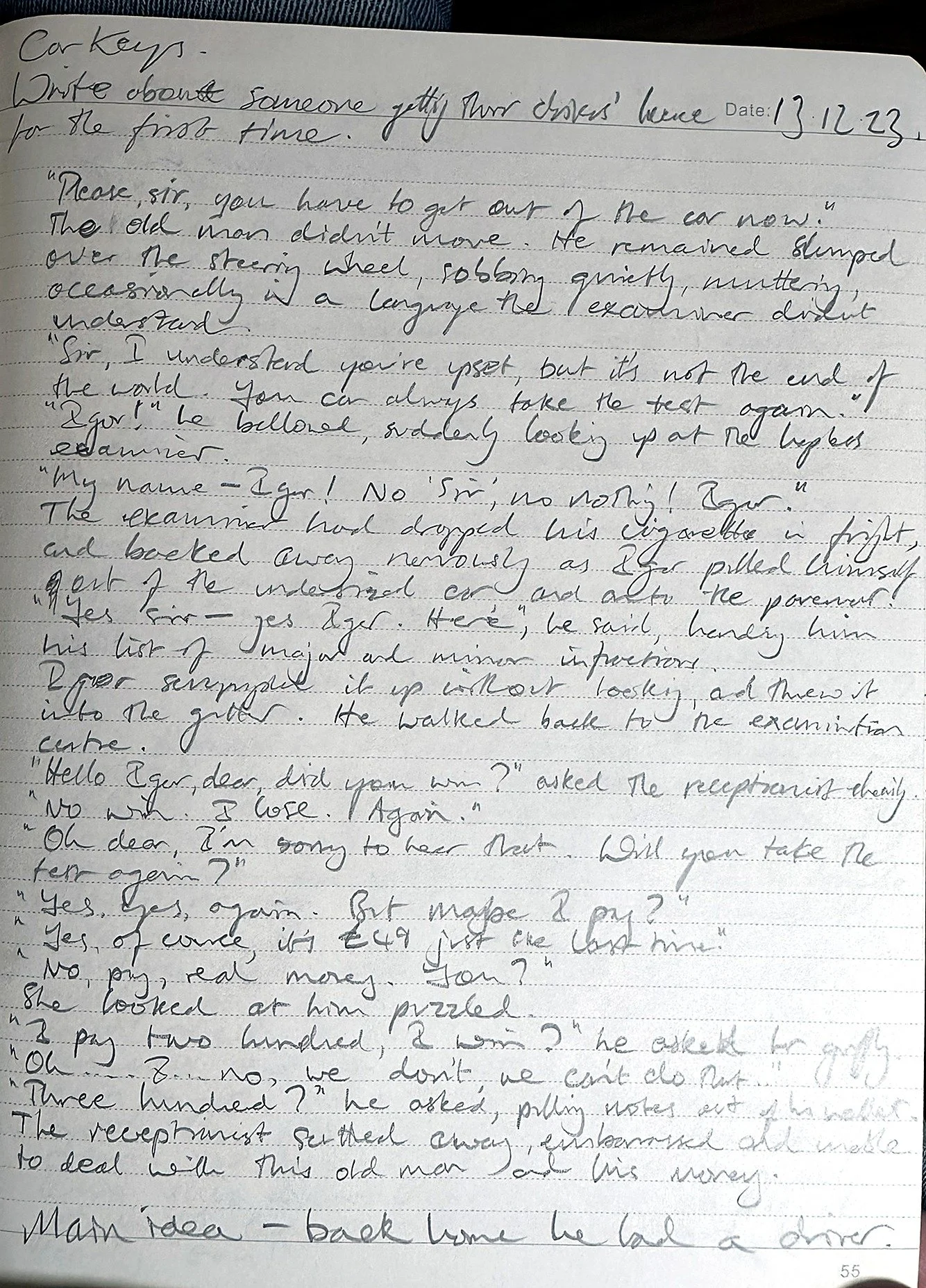
A page from Will Hackett-Jones’s notebook: the fifteen-minute exercise that became “His own set of car keys”.
You are also writing a novel in Russian, The Shugovka Yacht Club, about an American dreamer who opens a yacht club in a village of 500 people in Leningrad Oblast. Why did you choose to write it in Russian rather than English? What does writing in Russian let you do that English does not, and how does it feel to write fiction in a language that is not your first?
Oh, I'd never have chosen to write it in Russian. That implies agency over the story, which I don't have. It sort of downloaded into my head one day, parts of it, and I knew it was about Russia, for Russian readers, and that the description even, not to mention the dialogue, was sounding out in my head in Russian. So there we have it. It's been a nightmare — my Russian is by no means as strong as my English. Nor is my sensitivity to the nuance of the language. So it's been very slow and at times painful to write. But I'm nearly there. Then, of all the absurd things, when it's finished and clever people like developmental editors have helped me work it over, I'll have to translate it into English!
If there's an upside, it's that it won't sound translated in Russian. And hopefully it won't in English, either!
And I suppose it's also meant that I've avoided going on flowery, verbose flights of fancy, simply because I don't have the agility with the language to do it in Russian, whereas there's always that temptation in English. So perhaps it's made the book more approachable.
Which English-language writers matter most to you, and is there a book you keep returning to?
Steinbeck is always first on the list. I discovered him late in life, in my thirties, but he has floored me time and again with his books. I'm re-reading East of Eden now, and I've read Cannery Row a few times. He loves humanity, and you can see it in even his worst characters. He's a philosopher, but with a beer in hand and a cheeky grin to finish off his musings.
I love the early twentieth–century Brits, from Jerome K. Jerome and Kenneth Grahame to Roald Dahl, and of course C. S. Lewis and Tolkien. There's something about the tone of their writing that I love. It's elegant, intellectual but not academic. Spiritual. And funny. And then of course there's George MacDonald Fraser and his glorious Flashman character.
What are you working on at the moment, and where is the Igor story going next?
Igor’s had a break for a few months because there's been so much else to do. But he's still a few chapters ahead of you! He has more to come, and I just need to find the time to sit and talk with him. It'll get madder. It's a fun story to write — the whole book will be called Igor's String Theory when it's all put together.
I'm about 92% done with Shugovka, the yacht club book. That's my main focus now.
Then there are two more books planned — historical fiction about two regions of Russia. They'll be long projects requiring time in archives and all that, something I've never done before.
Oh, and I'm learning to draw so that I can part-illustrate Shugovka, so that'll be fun. A year ago my six year old could draw a more convincing stick man than I could. I've overtaken her now, though!